
Substance matters. But it’s surprising how much visual presentation shapes the way users judge web content.
Research shows that hiring talented developers, editors, and analytics experts isn’t enough. Skilled designers also influence how much trust users place in a website.
Visual attractiveness and source credibility
Marketing research has established a link between visual attractiveness and source credibility. With few exceptions, attractive communicators tend to be better liked, and this positively affects the products they represent. The source attractiveness model holds that a message’s impact depends on the endorser’s likeability, similarity, and attractiveness. Research has also shown that willingness to buy a product is statistically associated with perceptions of an endorser’s trustworthiness, expertise, and visual attractiveness (Ohanian, 1990).
The same pattern applies to websites. Websites can function like social actors making endorsements. Three findings from the research make this clear.
Three ways design affects credibility
First, website design can have a greater impact on consumers’ attitudes toward a website than their offline perceptions of the organization behind it. One study found a significant relationship between website design and user attitudes, with three of the six measured dimensions tied directly to trust and credibility (Long and Chiagouris, 2006).
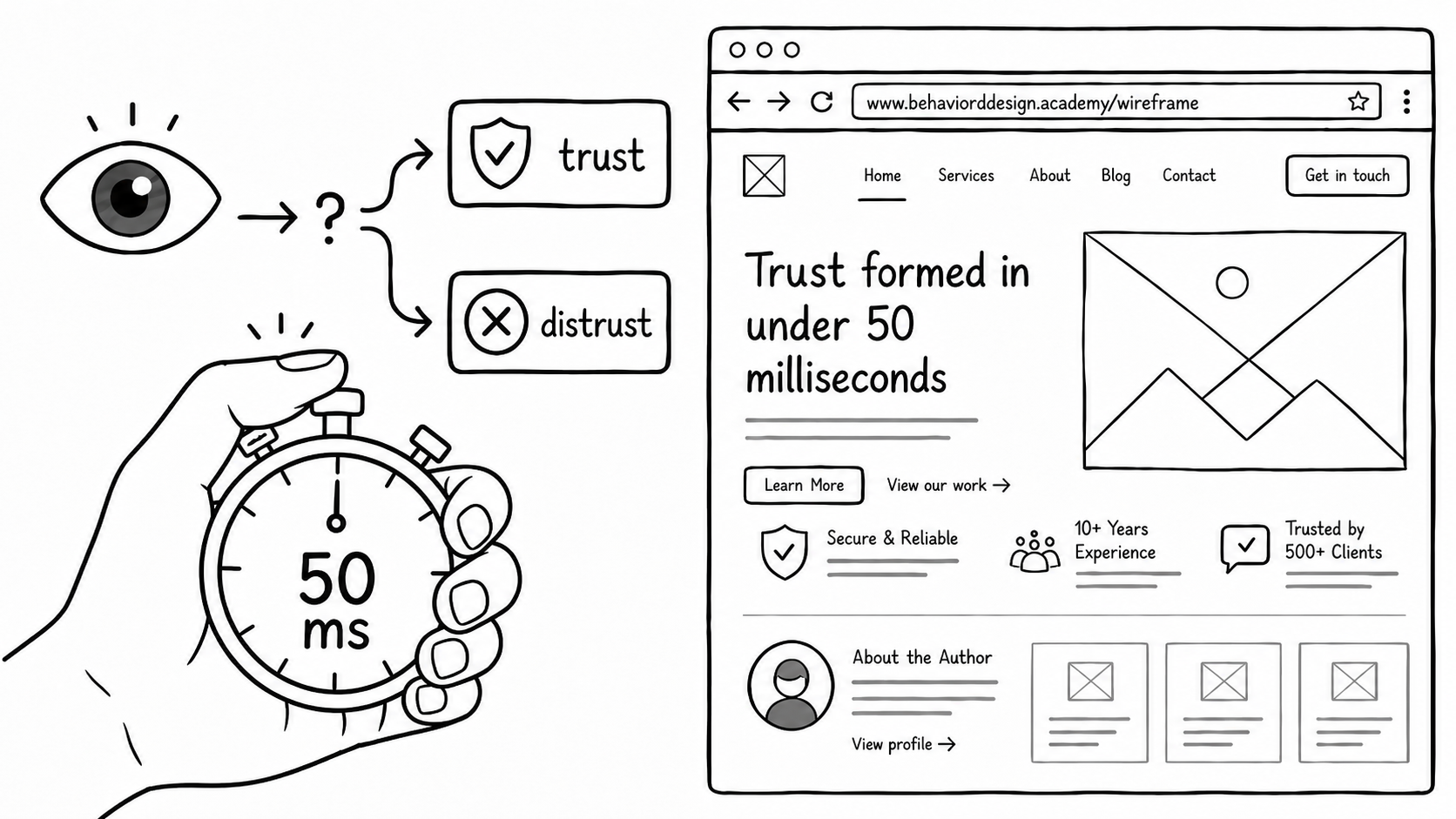
Second, website visuals trigger strong and lasting first impressions. Emotionally evocative design can increase a website’s influence and strengthen users’ memories of products. That first impression can form in as little as 50 milliseconds (Lindgaard et al., 2006). Visually attractive websites also produce a halo effect: a positive impression that can persist even after repeated negative experiences.
Third, one experiment showed the same health article to three groups: one with a photo of a high-credibility doctor, one with a low-credibility doctor, and one with no photo at all. The article content was identical. But readers rated the version with the more credible-looking doctor as most trustworthy. The version with no photo ranked second. The version with the low-credibility image ranked last (Nguyen and Masthoff, 2007). Same words, three different credibility ratings.
Interactive design is like persuasive rhetoric
Aristotle argued that persuasive rhetoric could make a weak argument stronger, and a strong argument stronger still. Website design works the same way. Good design can make content appear more credible than it deserves, and the people behind it more trustworthy than they are.
Design affects results. It increases the likelihood that users will believe your content, trust your organization, and act. Poor design signals the opposite.
When competing in saturated online environments, credibility is the factor that tips users toward you or your competition. The best way to appear credible is to be credible: be honest, be reliable, and build a reputation over time. But for legitimate new organizations, potential clients may have no way to tell if you’re the real thing. A professionally designed website, appropriate for your audience, is a reasonable starting point.
Users struggle with online trust
Credibility judgments are easily shaped by design and editorial skill. It’s no surprise that the internet has become a breeding ground for conspiracy theories, pseudoscience, and misinformation posing as fact (Thompson, 2008). One study found that 90% of participants could not identify a well-designed online scam, even when they were actively looking for it (Dhamija et al., 2006).
The takeaway: extend trust to reputable sources. Verify a site’s legitimacy before acting on its content or handing over money. Traditional signals of criminal intent are hard to spot online, and credible-looking design is easy to replicate. Looks can be deceiving.