
The next frontier of product design and research will focus heavily on AI-simulated humans. Human-like AI agents play many roles in product design (wireframing, storyboarding, visual design), but they’re equally playing a central role in research (UXR, social, and psychological studies).
When building agents, our goal is often to build believable, human-like AI agents. But the meaning of believability, and even the credibility of our agents, shifts depending on the type of agent we’re using and the application we’re focused on.
In this article, I’ll summarize a simple framework that helps clean up our thinking about human-like agents. It comes from a 2026 review in Nature Computational Science, and it describes four types of agents.
It’s an excellent taxonomy, but I spotted a major gap, so I added a fifth type of agent, the type that we care about most, in behavioral design. So in this article, explain five types of agents, show you how their agentic loop changes with each role, and explain how to evaluate whether you’ve built a good or bad agent.
What are the five types of AI-simulated humans?
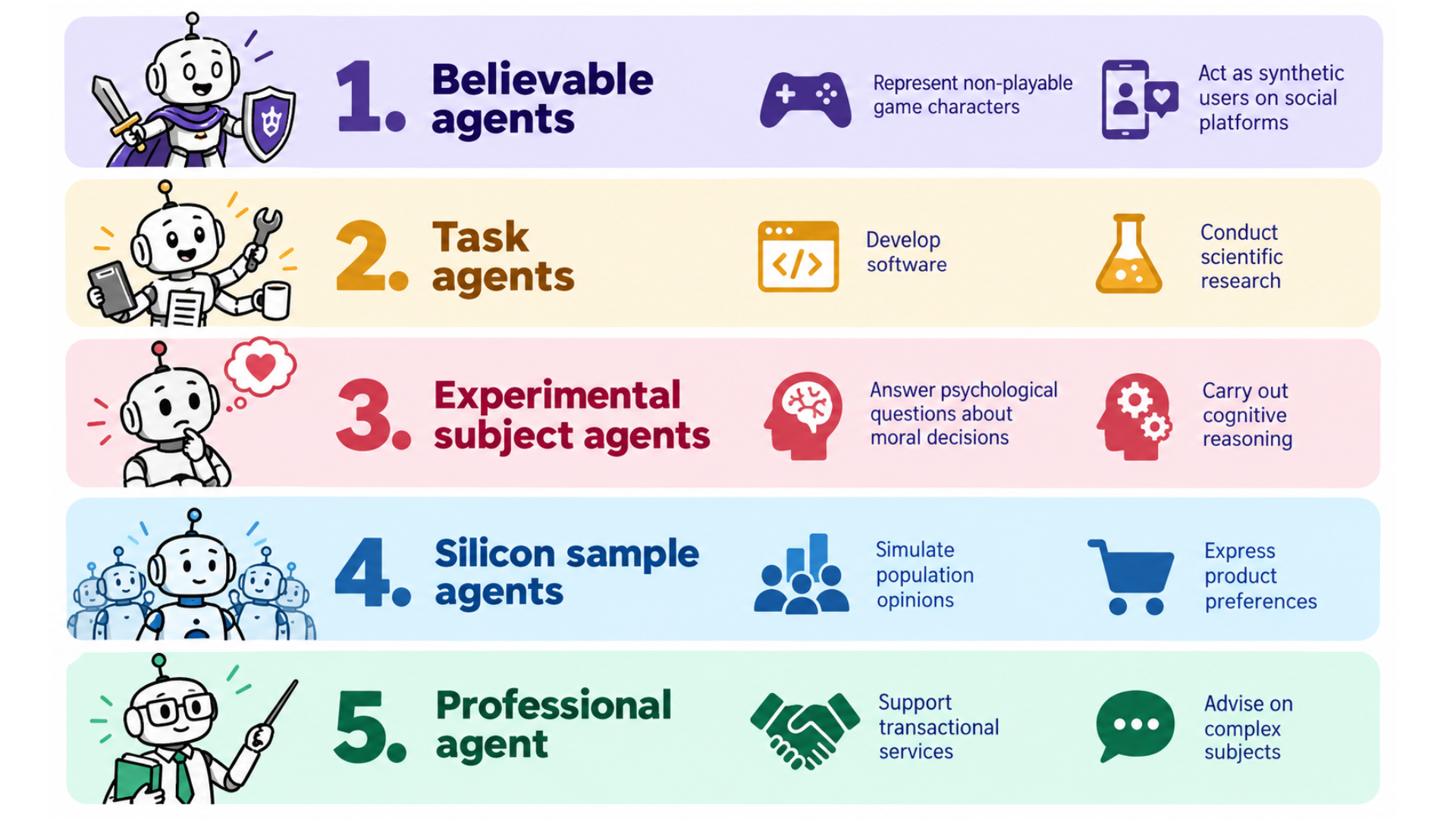
AI-simulated humans, also called human proxies, are AI agents with human-like qualities. There are five types: the first four from the original paper, with the fifth that I added.
- Believable agents play characters in games or on social platforms
- Task agents do human work.
- Experimental subject agents are when we study the psychology of each AI, itself.
- Silicon sample agents simulate human populations and people for research.
- Professional agents help users complete goals while providing services, support, and advice.
Let’s go deeper into each type of agent:
1. Believable agents
These are the characters we use in games or the fake bot-users we place on social platforms. The goal is for them to come across as credible and believable for the context. Examples include non-playable characters in a game world and synthetic users in social platforms that simulate an online community before it exists.
2. Task agents
Task agents help people get stuff done, and they are judged on the quality of their output. We care more about the work they do, not by how human they appear. For example, teams of task agents can design, write, and test software, or generate research hypotheses that scientists then test in real laboratories. Or the more advanced ones, can work towards a goal, evaluating their work, and trying many optional strategies before finally succeeding.
3. Experimental subject agents
This is the first of the two research types. Here, we study a particular AI to understand how it is different or similar to other AI platforms and humans, based on their psychological traits. Rather than trying to simulate human subject, we’re more interested in the personality, moral decision making, and thinking-style of the AI itself, so that we can for example, compare AI psychology. As an experimental subject, we want to know the AI’s default psychology out of the box? We can take almost any psychological study carried out on people, replace people with the AI, and use this to learn something about the psychology of each AI model.
4. Silicon sample agents
In the second research type, we use AI to simulate populations and individuals, then use these simulated people in psychological, social, and user testing. Instead of focusing on the AI’s default psychology, we intentionally bias the AI to mimic specific groups of people, or even individuals. Imaging digitally cloning a person into a large language model, and then instead of doing research on the person, we can now learn about that person by studying the AI photocopy of that person. So with a silicon sample agent, we’re getting it to act in a way that resembles our exact target audience or users, so that we can run cheap research that’s close enough to reality.
Rather than producing bad stereotypes of our audience, silicon sample agents should be as close as possible to the actual people in that population. That often means avoiding clichés and getting into the messy details that come with being a quirky, contradictory human. The closer to reality, the better the silicone sample.
5. Professional agents
This is perhaps the most well-established type of agent, dating back to early tailoring systems and older rule-based digital experts, advisors, and helpers. While the other agents perform tasks or provide information, these agents focus on helping users achieve something or experience some psychological change. While old-school agents relied on clunky if-then statements, the new AI-powered agents can support users in ways that are approaching human-like support.
These are AIs that take on professional roles, acting as company representatives, advisors, therapists, salespeople, and any social touchpoint. Human-AI interaction will replace many jobs that depend on human-human interaction, because we’re just swapping out people for AI. Right now, this agent role isn’t as well developed, and there are many regulatory barriers, but over time, I predict that this type of agent will become extremely popular.
These agents range from routine to high-stakes support:
- Low-risk advice: Routine roles replace help desk staff, telephone support, and transactional support, such as finding someone’s phone number, scheduling meetings, or helping people accomplish something.
- Medium-risk advice: Advisory roles carry greater risk and higher stakes, often in fields where bad advice can be harmful. These include financial advisors, nutritional advisors, career counselors, salespeople, educators, coaches, and more.
- High-risk advice: Full professional services carry the highest risk and often operate in regulated environments where lousy advice or mistakes can be lethal. These include psychological counseling, medical providers, and many fields where poor advice can cause serious harm, breach laws, or put companies at legal risk.
These agents need to combine their subject matter expertise, with behavioral science, so that they can engage users in a way that will make an impact, be accurate, safe and best positioned to motivate users through the right psychological approach.
Each type changes how you use the AI
Depending on which of these five goals you’re pursuing, you’ll prompt the AI and use it in a radically different way. A believable agent gets a persona and a memory. A task agent gets tools and a plan. An experimental subject agent receives a psychological survey. A silicon sample agent gets instructions to act like a group of people. A professional agent mixes expert knowledge with behavioral science strategies. They serve different purposes, run on distinct agentic loops, and then we evaluate their performance based on their distinct goals.
The agentic loops for each human-proxy
What I appreciated most about the author’s taxonomy was the idea of classifying agent types by their distinct agentic loops. What’s an agentic loop? It’s the cycle developers use, when building agentic systems. A basic loop consists of input, process, and output, with the output being inputted in to the next cycle.
But depending on the type of agent, the loop will have distinct steps, processes, and information that it works with. By understanding each loop, we better understand what goes into building each type of agent, and how to judge whether we’ve built a good or crappy agent. So let’s go over the loops.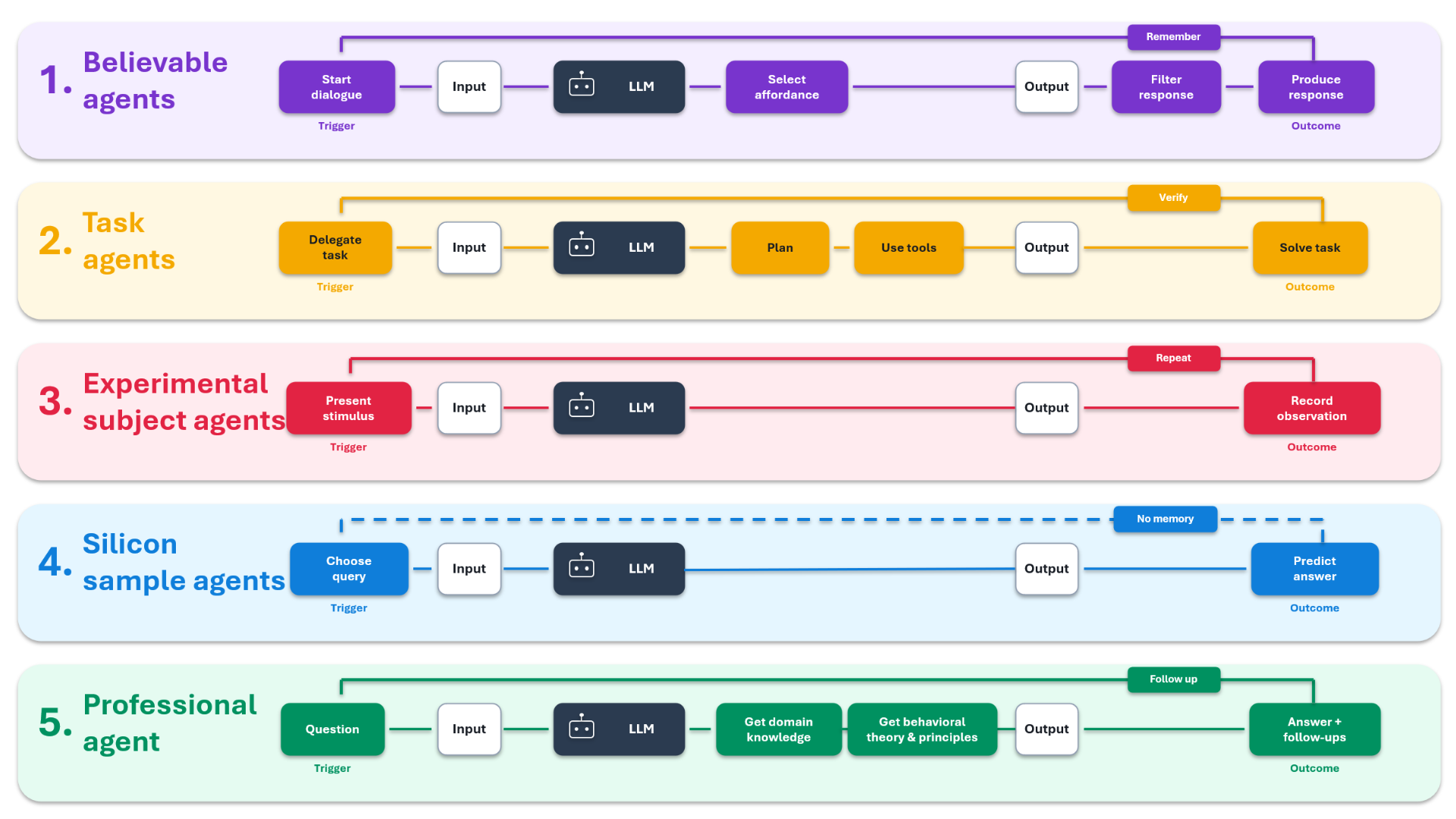
1. The believable agent loop
For a believable agent, we’re building a simple, chatbot-style system. It takes dialogue, then outputs an action, a response, or both, within its digital environment. We then filter that response for quality control and send it back to the user. The agent also stores each interaction to create a memory of its prior conversations, so every new exchange builds on the past.
2. The task agent loop
Here, the agent is working toward a goal. The user delegates a task, then the large language model develops a plan, implements the plan, and finally evaluates its performance. It may select different strategies and tools before producing each output. At the end, the agent evaluates if it has reached its goals. If not, it loops back and tries again. It keeps looping around until it finally succeeds and then presents the final output.
3. The experimental subject agent loop
This is the simplest research loop. We’re running standard psychological experiments that we’d typically run on people, except now we’re asking the AI to complete them.
Researchers might ask which AI is the most extroverted: Claude, ChatGPT, or Grok? Or which is the most good or evil, measured by how likely each is to protect or kill innocent people in a moral dilemma game?
Every AI, and every version of each AI, has a unique personality, moral disposition, and ways of acting on its emotions. And yes, the evidence shows that you can evoke the emotional associates of an AI, which biases it to act in a way that humans, in the same emotional state, act. There’s no fancy prompting for this type of agentic loop. We just ask LLMs to complete questionnaires to measure their default psychological characteristics, with no special instructions.
Because we’re studying one AI rather than sampling a population, it’s normal to ask each AI to complete the same questionnaire several times and then average them, as each run will vary. This compensates for temperature settings, which adds a lot of variability to the outputs, but by averaging, we get a reasonable estimate of each AI’s psychological disposition.
4. The silicon sample agent loop
This loop goes beyond the experimental subject agent loop, with one key refinement. We’re not interested in the AI’s overall bias. Instead, we’re interested in the biases associated with each distinct population. Assuming the AI has enough information about the group or people we’re interested in, we’re data mining the vector embeddings to impersonate each population.
This makes silicon sampling prompts more complex because we’re getting the AI to mirror specific people. And since we’re simulating a population, each loop can represent one person completing one questionnaire. But some silicon sampling architectures use multiple sub-loops per informant, so the loop depends on the architecture.
5. The professional agent loop
With the goal of helping or nudging users, these loops focus on identifying users’ goals, retrieving relevant knowledge, and mixing it with the most appropriate behavioral science principles to help or nudge users towards some goal.
This is a classic example of how I use the Interactive Behavior Change Model (IBCM), the only behavior change system designed specifically for human-like agents and technology. By combining professional knowledge with behavioral science know-how, this loop moves users toward some type of change.
While simple professional agents just provide transactional information, others are built on full coaching models grounded in behavioral science theories, with a mix of psychological strategies designed for the task at hand. Medical bots can go beyond education, into encouraging people to live healthier lifestyles. Sales bots can help people make informed decisions, while nudging them to get a slightly more expensive product. Accountant bots can help people clean up their taxes, while encouraging them to file on time. And it must act in the user’s best interests, their safety, and wellbeing.
With decision support systems, they also use behavioral science principles, but with the opposite goal: to remove the LLM’s default persuasive disposition so people can make decisions with minimal cognitive biases and persuasion being pushed by the LLM’s default behavior.
Whether your professional agent is built to nudge or not, it needs expert knowledge combined with psychological insights so it can present its expertise in the most impactful way.
How do you know if your humanized AI agent is performing well?
Success with one type of agent doesn’t carry over to another. In a video game, a believable agent only needs to mirror clichés, but this would ruin a silicon sample, which must be as quirky, contradictory, and stereotype-breaking as real people.
In evaluating our agent, the criteria change with each type. Here’s how we can judge the success of each agent.
| Agent Type | Success criteria |
| 1. Believable agent | It seems like a legitimate character for the context. |
| 2. Task agent | It performed the task you asked of it. |
| 3. Experimental subject agent | You get back reasonably reliable psychometric data about the AI. |
| 4. Silicon sample agent | Its answers come close enough to real human data. |
| 5. Professional agent | The person, or the goal they’re pursuing, changed in the intended way. |
What are the practical takeaways for designers and researchers?
This taxonomy offers practical guidance for anyone using human-proxy AI in product and behavioral design. Here are five practical tips:
- Decide which type of agent you’re building from the onset. Each type has different goals and succeeds in different ways. A believable agent that convinces your game users with cliches will probably fail as a silicon sample that needs real, contradictory humans.
- Map your exact agentic loop. The loop shapes how you prompt the agent, what it remembers, how often you run it, and what a good output looks like. If you can’t sketch the loop’s flowchart, you don’t understand enough to design it.
- Define success metrics for each agent type. A believable agent might be judged on mimicking cliches, a task agent on accuracy, an experimental subject agent on consistency, a silicon sample on how well it matches real human data, and a professional agent on user outcomes and safety. If you borrow another type’s metrics, you’ll optimize for the wrong outcome.
- Humanize your AI only as much as the job requires. Game characters rarely need deep human emotions. Silicon samples need to be as close to real people as possible. Professional agents need to act professionally, without creeping out users, offending customers, or blundering with psychological backfires.
- Understand how people form emotional relationships with technology. The more human-like your agents, the more people may trust or distrust it, confide in it, and form an emotional bond with it. That can make professional agents more effective, but it also raises the stakes when they give bad advice, annoy users, or nudge people in ways you did not explicitly design for.
Where is human-like AI headed?
We’re still in the early days of humanized artificial intelligence, and this taxonomy will probably grow as human-like technology becomes more embedded in our daily lives. But the core lesson will hold: before asking how human an AI should be, ask what it’s doing and how its loop works. That’s where good design starts.
References
- Karetnikov, N., Rahwan, I., & Svetinovic, D. (2026). Large language models as human proxies. Nature Computational Science. https://doi.org/10.1038/s43588-026-01060-3
- Cugelman, B., & Stibe, A. (2023). Interactive Behavior Change Model (IBCM 8.0): Theory and ontology. In International Conference on Mobile Web and Intelligent Information Systems (pp. 145–160). Springer Nature Switzerland. https://memorial.scholaris.ca/server/api/core/bitstreams/c2a67c3f-729f-40d7-b2e5-b39ff4371113/content
- Sofroniew, N., Kauvar, I., Saunders, W., Chen, R., Henighan, T., Hydrie, S., … & Lindsey, J. (2026). Emotion concepts and their function in a large language model. arXiv preprint arXiv:2604.07729.
- Kreuter, M. W., Farrell, D. W., Olevitch, L. R., & Brennan, L. K. (2013). Tailoring health messages: Customizing communication with computer technology. Routledge.