
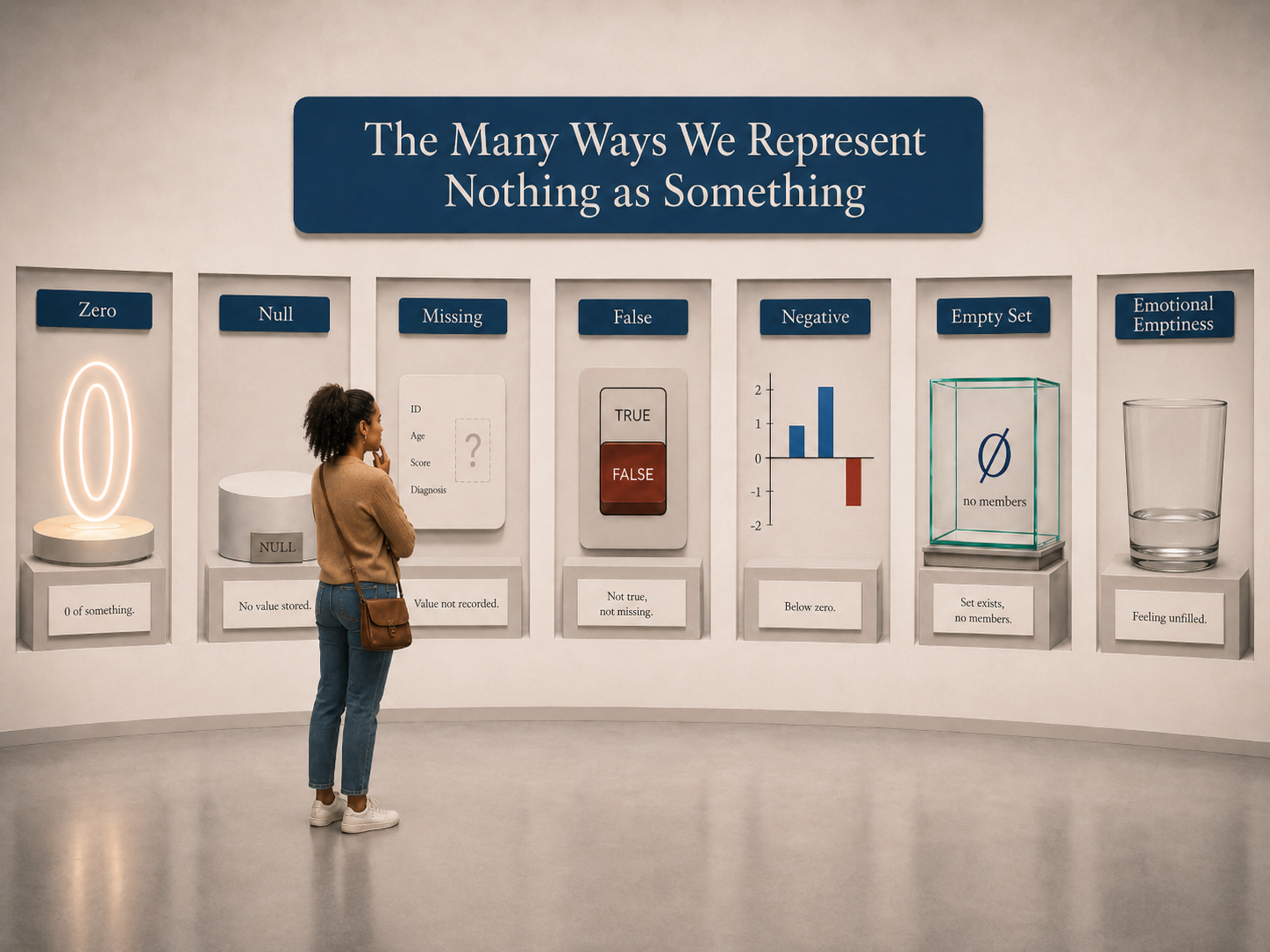
Zero is one of mathematics’ most misattributed inventions, originating in India. Before the invention of zero, abstract math was extremely difficult. After zero, it transformed our understanding of the universe. And yet, for something so simple, the human brain handles it in a surprising way.
New neuroscience suggests the brain doesn’t encode zero as an absence of something, or as no signal. Instead, it uses a specific neural pattern to represent “nothing,” treating zero as a thing in its own right. Which raises a question with real consequences for research, design, and even existential philosophy: if the brain represents nothing as something, what happens when there are multiple types of nothing?
In this article, I’ll go over the concept of nothing, discuss some of the new brain science findings, and then get into different types of nothing.
How the brain represents zero
The neuroscience is counterintuitive. You might expect zero to register in the brain as a simple absence: no signal, no activity, no encoding. But that’s not what researchers are finding. Zero appears to have its own dedicated neural representation, positioned alongside other numbers on a mental number line, yet also treated as categorically different from them.
Children take longer to grasp zero than countable numbers, which suggests it isn’t just a smaller version of one or two. It requires a different kind of conceptual leap. And even in adults, zero sits in an odd cognitive position. It is both an ordinary number sitting on the line, and something unique: the complete absence of quantity.
The brain encodes nothing as something. It gives “zero things” the same cognitive status as actual things. That’s what allows us to reason about absence, to distinguish between having nothing and having no information at all.
But it also sets up a systematic confusion that can sabotage your research, and I suspect helps to explain our human sense of meaninglessness that drives civilization.
Types of nothing
There are many types of nothing, and they don’t all mean the same thing. Some are intellectual: the concept of absence, of a value that doesn’t exist, of a question left unanswered. Others are emotional: a felt missingness, a hunger, a longing for something that isn’t there.
Because the brain represents nothing as something, it treats different kinds of absence as things that exist, despite being defined as something that does not exist. Understanding what kind of nothing you’re dealing with helps us cognitively to better work with data, and emotionally to better manage our irrational human motivations.
Let’s go over two broad types of nothingness.
Cognitive nothingness: zero, null, and missing data
In the intellectual domain, nothingness comes in several distinct forms. Zero, null, missing, false, empty: these all represent some version of “nothing,” but they mean fundamentally different things. Confusing them is one of the most common sources of error in data management and quantitative research.
The core distinctions are these:
- Zero. A numerical value representing the absence of quantity. We have data. Its value is zero. That’s meaningful information.
- Null. The absence of any value whatsoever. Not zero. No value at all. Null is a known unknown: we know there’s no data, but we have no basis for saying what it would be.
- Missing. A placeholder used in research to flag skipped questions, non-responses, or data that couldn’t be collected. Missing data is not zero data. Treating it as zero corrupts your analysis.
- False. In Boolean logic, false is not zero, but many systems encode it as 0, which creates constant errors when data moves between systems or is misread.
- Empty string. A valid value containing no characters. It exists; it just has no content. Different from null, which doesn’t exist at all.
- Whitespace. Spaces or tabs that appear empty but aren’t. Not an empty string, not null.
- Default value. A value automatically assigned by a system when no input is provided. Not the same as a user-entered zero or a genuine absence of data.
In professional research, these distinctions are built into the tools. Today, most statistical tools provide a dedicated missing values dialog that forces researchers to define their missing data conventions before analysis begins.
The convention shown, using 999 and 888 as discrete missing value codes, is standard practice in survey research. A common three-code system works like this:
- 999: I do not know.
- 888: Not answered or skipped.
- 777: Other reasons for missing data.
The rule is simple: never use 0 to represent missing data. Zero is a legitimate data value in most scales. Using it as a missing data code corrupts your dataset in a way that’s easy to miss and hard to untangle later. The lesson here is that if you confuse the wrong types of nothing, your analysis can go off the rails. Good research includes having a solid strategy for managing the full spectrum of nothingness.
Emotional nothingness: the meaning gap
There is a felt dimension to nothingness that operates differently from the intellectual form. Emotional nothingness isn’t a category of missing information. It’s an experience of emptiness, of hunger, of pressure to fill some void. It’s a longing for something absent, a sense that something is missing without always being able to name it. But what these experiences share is that we can put a name to the gaps, even when we can’t always name what’s missing.
These gaps play a powerful role in human motivation, often far more motivating than positive desire. I believe that we humans have an existential meaning gap, which can feel unpleasant, even painful, as a void that we feel motivated to fill.
Dopamine is a case in point. The dopamine system doesn’t fire hardest when we get what we want. It fires hardest in anticipation, in the pursuit. We feel more motivated, more energized, and more alive when chasing something. It’s when we hunger that we are most motivated. But when we feast, our motivation quickly dissolves. And when we find ourselves longing again, the emptiness reopens and our drive returns.
In people with a predisposition to addiction, this dynamic becomes catastrophic. The craving is so strong and the void so unfillable that it sends people on an impossible quest to fill a hunger that can never be satisfied. Once satisfied, the void deepens, pushing them into an endless vicious loop of pursuit of that which they believe will be fulfilling, but which always leaves them even more unfulfilled. The more they try to fill it, the emptier they become, entrenching a habit that is extraordinarily difficult to escape.
I’m certain that I do not have an addictive predisposition, so I only have a textbook understanding of addiction and insight from speaking to those who live with it.
Viktor Frankl’s Man’s Search for Meaning is one of my all-time favorite books, and it speaks directly to this. Frankl was a psychiatrist who survived Nazi concentration camps and developed logotherapy, which you can think of as an existentialist therapy to help people find meaning and live a fulfilling life.
Many of the inmates worked as slave laborers under brutal conditions that are beyond comprehension. Frankl observed that people who stopped taking care of themselves, who gave up on the basic acts of survival, would typically die soon after. What he wanted to understand was what separated those who kept struggling to live from those who let themselves go.
What he found was that people who had something to live for: a future vision, a purpose, something that pulled them forward, kept going. Almost any purpose, no matter how small, was often enough to keep people motivated to fight against the hardship. Even a small purpose seemed to be enough to fill people with a genuine reason to go on, fight to live, and endure endless pain. But when people had no future goal, when the gap had nothing worth filling it with, they gave up.
Frankl’s observations in the concentration camps map closely onto modern animal research on depression. I often warn people before sharing how some antidepressant drugs are tested, because it can be emotionally distressing. It cuts to the heart of what motivates us, and seeing any living creature at the give-up point is always a difficult sight.
Here’s how it works. Scientists testing antidepressants place genetically depression-prone mice in water and measure how long they swim before giving up. Depressed mice stop sooner. Drugs that extend their swimming time are candidates for antidepressants that may work in humans. It’s a blunt measure, but it captures something real: the motivation to endure life’s hardship. What Frankl observed in humans under extreme conditions, and what these experiments measure in rodents, point to the same dynamic. This became a cornerstone insight behind his logotherapy approach.
Here’s a personal example of how it works. When I was finishing my doctorate in the UK, my grandmother made me a deal: she promised she wouldn’t die if I promised to return to Canada. We shook hands on it, and over the years used to laugh about our agreement. My family made sure I didn’t forget it either, and yes, family guilt is far more powerful than behavioral science.
But in the end, we both kept our end of the bargain. She lived into her early nineties, and my aunt actually believed the deal was a real factor in my grandmother’s motivation to keep going. When people have even small goals, the meaning void stays filled up enough to keep motivation healthy.
I suspect the existential vacuum isn’t nothing. It’s felt as something, conceptually like a pressure for completion, wholeness, or a value pushed to return to some baseline. And I suspect our search for meaning, our drive to fill the empty cup, is what moves us humans to play our human games, which is ultimately what brings about our civilizations.
Nothing is something
Understanding that nothing is something, and that it operates in different ways, helps us better understand and manage its many forms. It will make you a better researcher, a clearer thinker, and help you understand human motivation. And perhaps it will put you on the path to living a more fulfilling life.
References
- How the Human Brain Contends With the Strangeness of Zero, Quanta Magazine. https://www.quantamagazine.org/how-the-human-brain-contends-with-the-strangeness-of-zero-20241018/
- Frankl, V. E. (1985). Man’s search for meaning. Simon and Schuster.