There’s an old saying: it takes a village to raise a child. A healthy society runs on a diversity of viewpoints. The internet promised to bring more of that. In many ways it has. But social media has also become one of the biggest drivers of political polarization we’ve ever seen. The divide between left and right has left civil discourse, and the culture war defines an ideological fracture point that is too toxic to be ignored.
Those debates touch on some deep assumptions about human nature. Behavioral science has a lot to say about them.
I normally focus on the psychological side of digital products and campaigns. But the same concepts we use in design play out at a much bigger scale in society. In this article I’m zooming out to look at bias and stereotyping from a broader social perspective, specifically through the lens of polarization, which is one area where psychology can help us not just understand what’s happening, but maybe do something about it.
I didn’t get a PhD in behavior change to specialize in what makes people click on buttons. A large part of my career was focused on using technology for social change: changing laws, policies, and institutional agendas.
Upstream and downstream approaches to social change
There are two popular paths to changing society: downstream and upstream approaches.
The downstream approach is based on getting people to take voluntary action. The upstream approach works through the reform of institutions and laws, which is where I spent much of my career.
To get results, you normally need to go upstream and downstream at the same time. While upstream change creates the policy framework that enforces lasting change, it’s the downstream work that builds citizen support.
As a practitioner, impact evaluator, and scientist who has worked on the front lines of many social change programs, I know how hard people work to implement real change. Unfortunately, very few of these efforts materialize into real results.
Despite the hype, you’ll rarely hook a population on a social change program. But with a good behavioral science approach, you’ll normally make a modest and significant impact.
Will the global drive for equality fade away once the passion subsides? Or are we seeing long-lasting change that will make it into the history books? To answer that, we have to look at what’s being proposed.
The debate over defunding the police
Police reform is a controversial subject.
If you disempower the police too much, you risk empowering criminals and growing crime. When the UK stopped police from carrying guns, there was a surge in gun crime until tactical marksmen units were established.
If you overpower the police, communities feel like they’re under military rule. This creates resentment from overpoliced citizens.
What’s the difference between a military and a police force? One key difference is their level of access to lethal force.
In the USA, where almost anyone can buy guns, including military-grade assault rifles, it’s hard to see how police can be meaningfully disempowered. It’s also hard to see how officers will lose their fear of being shot on the job, or how anyone they distrust will feel treated with respect, when the threat of gun violence shapes every interaction. The free flow of guns is the elephant in the room that many people ignore in these debates. Countries with unarmed police also tend to have unarmed citizens or extremely tight restrictions on access to weapons.
What I want to focus on here is how we deal with systematic bias. Not just the bias that leads some police to treat groups differently, but the bias embedded in social structures and institutions.
When we talk about removing bias, it’s not a straightforward task of identifying the good vs. bad biases and fixing them. We can’t see these biases, because they’re the structure through which we perceive reality.
What makes this more complex is that those who fight bias are sometimes the worst bigots themselves. There’s a reason the saying “where they burn books, they will also burn people” has held up. People who fight bias can push their own “good” biases to replace what they deem the “bad” ones, and the process can turn into a witch hunt.
When it comes to fixing police bias, the answer isn’t removing people who think the wrong way. It’s understanding how biases work, and building police cultures that serve the communities around them.
Can we eliminate bias, or are we hardwired for it? Is equality a social construct, or are we genetically predisposed to react emotionally when confronting inequality? Here’s what the science says.
Are we biased toward equality?
Bias is normally seen as a negative thing, but what about the emotions that push us toward equality? You’d probably call that a good, or ethical, bias.
Mammal studies suggest that the concept of equality wasn’t invented during the French Revolution. It’s hardwired into our emotional systems. Primatologist Frans de Waal has documented this in a classic study worth watching:
Paper: http://saki.caltech.edu/biCNS217_2008/PDFs/Brosnan2003.pdf
The study shows that when primates receive unequal compensation for the same work, they become angry and disrupt the process. Notably, this response affects both groups: sometimes the primate that received the unfair advantage will also rebel against an unjust situation.
Similar studies have been conducted on other animals. One showed that wolves become so enraged by inequality that they start destroying their cage.
There’s also a fascinating body of research many people haven’t heard of: baby ethics studies. These show that we’re born with a sense of right and wrong, and we express it before we can speak. When babies see someone disrupt others or act unfairly, they’re more likely to ignore and punish the bad actor.
You can get an overview of the baby ethics studies here:
Since the research suggests equality is hardwired into our psychology, it raises a question: why is there so much inequality in a species with a clear emotional bias toward equality and justice? Apparently, there are other emotions shaping our behavior. More often than not, emotions we don’t always like to admit.
Are stereotypes accurate? What research shows
This is a loaded question. We’ve been told our entire lives that stereotypes are bad and need to be opposed. But psychologists and neuroscientists have found that humans are hardwired to be biased, and that our biases are more likely to be correct than incorrect. There’s a real contradiction in humanity here.
Here’s what the neuroscience shows. We’re hardwired to perceive the world through categories. The brain is a classification and prediction machine. Sensory experiences are automatically classified based on past experience, which fires emotions we can’t consciously control.
My view is that if you want to fight bias, you need to ground your efforts in an accurate understanding of how the human brain works. Otherwise, you risk building interventions that fail because they’re based on an idealistic, not a realistic, picture of human psychology.
I’m a fan of Prof. Lee Jussim, a specialist who studies the factual accuracy of human bias. His work is controversial because it shows that many human biases are more accurate than people like to believe.
Before someone accuses me of promoting racist stereotyping, I want to be clear about where I’m coming from. I come from a line of people who’ve been managing bias for some time. One of my grandfathers changed his last name from Cugelman to Cook to avoid religious intolerance. My other grandfather, a Canadian soldier during World War II, said he didn’t need to go to Germany to fight bigotry because he had plenty to deal with in Canada. For the family members who stayed in Europe, some were sent to Dachau. I have no information on other family lines, but assume they were killed for their religion or died in the war.
I’m not promoting racist stereotypes. They are easily manipulated and exploited. Aristotle’s Art of Rhetoric, written over 2,000 years ago, describes how to enrage a group and direct that anger at another. It’s essentially a manual for populism that’s still very much in the political playbook, keeping politicians empowered and citizens disempowered.
What I am discussing is our natural inclination to form impressions of people and groups based on patterns. Research on personality shows that the brain keeps statistical track of people’s behavior in particular contexts, then instantly notices any deviation. This is an unconscious pattern-recognition process on which we base our judgments of other people.
Research shows that on average, our biased impressions are more accurate than incorrect. Below is a discussion with Gad Saad and Lee Jussim on the science of human bias and how the scientific community is grappling with it. The neurological argument is that when we don’t have enough information to judge a situation, the brain uses prejudice to assess whether it’s a threat, an opportunity, or nothing significant. Once we can assess things more carefully, we rely less on heuristic rules and more on the actual content of our experience.
Yes, we humans are hardwired bigots, but the picture is more nuanced than that. We use prejudice to manage unfamiliar patterns, then quickly update our assessment once we have more information. We’re both biased evaluators and careful ones at the same time. This is a more nuanced understanding of bias, one that shows separate psychological and neurological processes working as part of a larger assessment system.
Another perspective comes from biology. You may know homeostasis as the body’s system for keeping its internal state optimal. Allostasis is a newer framework that describes how the brain constantly predicts the future and modifies our physiology to cope with situations. It helps explain how our emotions work and why we lose control during emotional situations.
Research on allostasis suggests our brain is constantly assessing situations and modifying our physiology based on predictions about what will happen next. This keeps us ready for what’s coming, but it means our brain’s classification system has more control over our emotions than we do. This is one of the best papers I’ve read on the subject: “Allostasis: a model of predictive regulation.”
Many dislike Lee Jussim’s research because it runs counter to idealistic beliefs about humanity. But there’s a glimmer of hope in his findings. While people use stereotypes to make quick decisions, research shows we constantly update our impressions based on actual experience.
What this suggests is that most people will make an exception to the rule based on what they actually experience. Yes, we’re biased. But humans are not destined to be entrenched bigots, and institutional bias is something that can be changed.
We have a high capacity to change our worldview by breaking stereotypes. The irony is that we replace the old stereotype with a new one. But that new stereotype is broader, built on more experience.
We can’t eliminate bias, but we can work with it
This natural inclination to update our perspective ensures that most of us will keep evolving our biases from narrow to broader views. We’ll still see the world in categories, and our emotions will always react without our conscious awareness. But the broader our worldview, the more we shape the classification engine that creates our biases. This brings us closer to better managing potentially negative internal biases.
Changing perspectives and biases takes time. But that’s what we do in social change. Prejudice is not immobile or entrenched. With the right shock or experience, people can change their worldview. The best expert I know of on how to drive this kind of change is George Lakoff, who wrote Don’t Think of an Elephant, on the psychology of framing.
The frames through which humans perceive the world are fluid and can be positively changed through different experiences.
We can’t reduce bias as such, because bias alone isn’t a bad thing that can be eliminated. Our only real option is to increase bias diversity by creating broader and more varied experiences, so that people’s narrow categories are replaced by wider ones as each of their rules about humanity is contradicted by exceptions.
To become less biased is to have broader biases. No matter what you do, we’re still going to be biased, because we naturally think in categories.
Given the need for a more just society, how do we build a society driven by the kinds of biases we value while reducing the ones we don’t? This is the million-dollar question. Multiple approaches have attempted it and failed.
Predicting your unconscious bigotry
How would you feel if I gave you a test that predicted how much of an unconscious bigot you are?
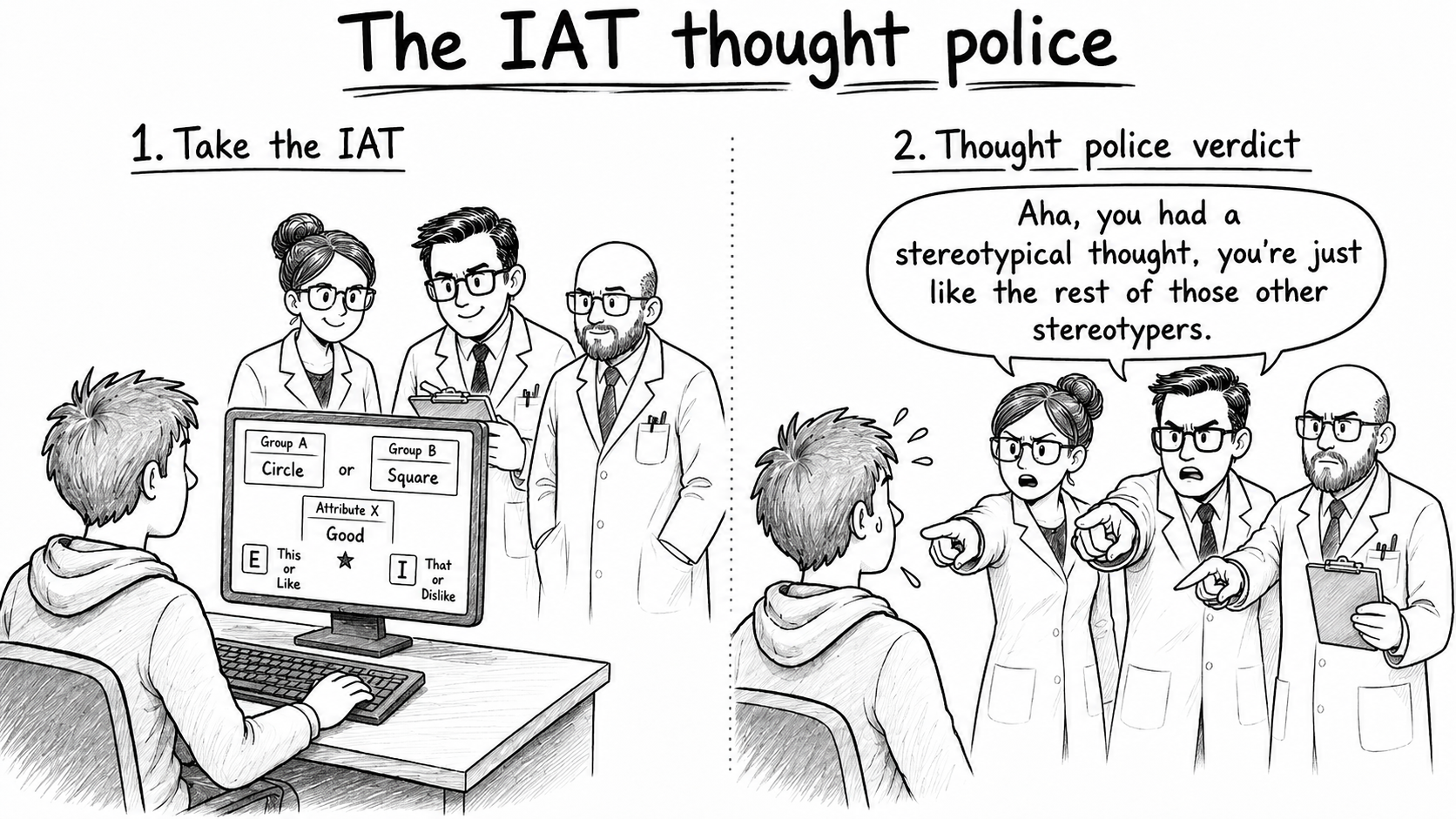
Companies already sell this test to corporations. It’s called the Implicit Association Test (IAT).
The IAT assesses unconscious bias by measuring incongruent thoughts. If someone has a strong sense of in-group identity and disregard for outsiders, the idea that “my in-group is good” and “your out-group is bad” is congruent. What may be incongruent are thoughts like “my in-group is bad” or “your out-group is good.”
If it’s unthinkable for a strongly biased person to accept that their in-group is bad, that resistance shows up in the speed at which they complete tasks. The incongruence forces the brain to process contradictory information, which slows response time. The IAT measures exactly that.
As you can imagine, a test that claims to identify unconscious bigots is controversial. In corporate settings, it functions as a thought-police tool.
The IAT is a serious research instrument. But not everyone agrees it can be taken out of the lab and used for workplace screening. I share that skepticism. Here’s a discussion by Jordan Peterson on the misuse of unconscious bias testing:
Want to test your own biases? Take the IAT here: https://implicit.harvard.edu/
Structural reform: is it possible?
Let’s be honest. The world is unfair.
I’ve always felt that humans are hardwired with two opposing motivations: the drive for equality and the drive for an unfair advantage.
You could call these compassion versus greed. But the moment we apply these emotions to our social psychology, things get messy.
The ideal of equality is worth striving for, but it’s difficult to achieve because not everyone wants it.
From my experience, we will never have complete equality, because it only takes a few individuals to disrupt a social structure built on that principle. One blue-collar criminal at the bottom or one white-collar criminal at the top can corrode an entire community and the trust that flows through it.
A small percentage of humans have low-reacting amygdalae and almost no moral compass. They don’t care what they do to other people to get what they want. We call these people psychopaths and sociopaths.
While psychopaths are biologically born this way, sociopaths become this way through their upbringing. For a clear breakdown of the distinctions between psychopaths, sociopaths, and narcissists, Dr. Ramani’s video on the subject is worth watching.
There will always be people who don’t care for equality, and they will exploit whatever structures we build to defend it. The capable ones rise to the top and use their position to abuse these systems for personal gain. The others sink to the bottom and use crime to get their unfair advantage.
George Orwell nailed it in Animal Farm with the declaration that “some pigs are more equal than others.” It’s an inconvenient truth, but it’s hard to argue with. As humans, I think we’re cursed to participate in a moral tug-of-war between compassion and greed.
Since most humans are predisposed to feel equality emotions and a few are not, society is destined to be in a constant battle between equal and unequal social structures. We continuously have to calibrate the pendulum.
Perhaps this is part of our adaptive social structure. Short of using CRISPR gene editing to revise our genetic code, I don’t see inequality ever being fully removed. To engineer out greed and create 100% caring humans would be to create another species.
Will the mass protests result in structural reform? That will depend on lobby groups and politicians carrying the momentum forward. We’ll certainly see idealistic political speeches, but once the anger subsides, the motivation will slow and the push for change will gradually lose steam.
I don’t believe we will ever remove bias. It’s how humans think, and not everyone has a moral compass.
How psychology can help us tackle social conflicts
I don’t have the answers, but here are some thoughts.
For top-down change, we should build diverse institutions and police systems that reflect the communities they serve. Hiring cadets with more education would help too. Cultural similarity builds trust and broadens the mindset of the institution.
For bottom-up change, we should build local community ownership, empowerment, pride, and hunger for change. When a group fights for its own rights, it’s more likely to build the kind of motivation required for lasting change.
Good policing requires citizens who care about their community and want to see it improve. If the momentum from the protests can be channeled into a cultural transformation, that would be a legacy likely to produce real results.
Grassroots mobilization is key, because large-scale community change is measured in decades. You need revolution-grade motivation to see these changes through.
The biggest challenge I see is keeping institutions honest and accountable to the people they serve. I can’t fully answer that, because I assume all institutions go through highs and lows as their leadership and cultures change over time.
But it’s those ethical lows that concern us here. You know you’re in a morally vacant organization when staff believe the company’s values statement is total nonsense. People’s sense of connection to an organization is literally measured by asking staff how their personal values align with the organization’s values. That’s why ethics matters for leadership.
Cultural diversity plays a role in protecting institutions against corruption, but it’s only one factor. It takes only a few brilliant but unethical individuals to erode an organization’s values and culture.
During my time in government, I worked with many incredible people who genuinely acted in the interest of the people they served. I also worked with some who didn’t, and occasionally took sides against them.
I’ve represented the United Nations and the Federal Government of Canada, among other organizations. In my time, I did my best to defend their values and counterbalance the dysfunctional parts of the system.
But corruption is real. Institutional cultures can quickly lose their way under incompetent or unethical leadership, or under the influence of a dysfunctional trade union.
I don’t have a clear answer on how to keep institutions honest and accountable to citizens, other than faith in democracy. In a democracy, at least, citizens can vote to fix the parts of the system that fail.
When problems are bad enough, politicians can win elections by promising to fix them.
This is part of what we’re witnessing in the response to the George Floyd killing and the black lives matter movement. Only time will tell what happens, but something significant is in motion.
By Brian Cugelman with editorial support by Nathaniel Mansfield