Seeing your life as a Hero’s Journey can make you happier, more resilient, and more fulfilled.
But these same principles can also transform your digital products, helping you create more motivating and meaningful user experiences.
In this article, I’ll share insights from a recent paper on the psychology of the Hero’s Journey. I’ll explain what it is, guide you through a simple exercise to help you experience its psychological effects, and explore how you might heroify your own digital products.
What is the hero’s journey
For those unfamiliar, the Hero’s Journey is a narrative structure developed by Joseph Campbell, in The Hero with a Thousand Faces. He identified common plot stages in myths and epic tales that have endured across cultures for thousands of years.
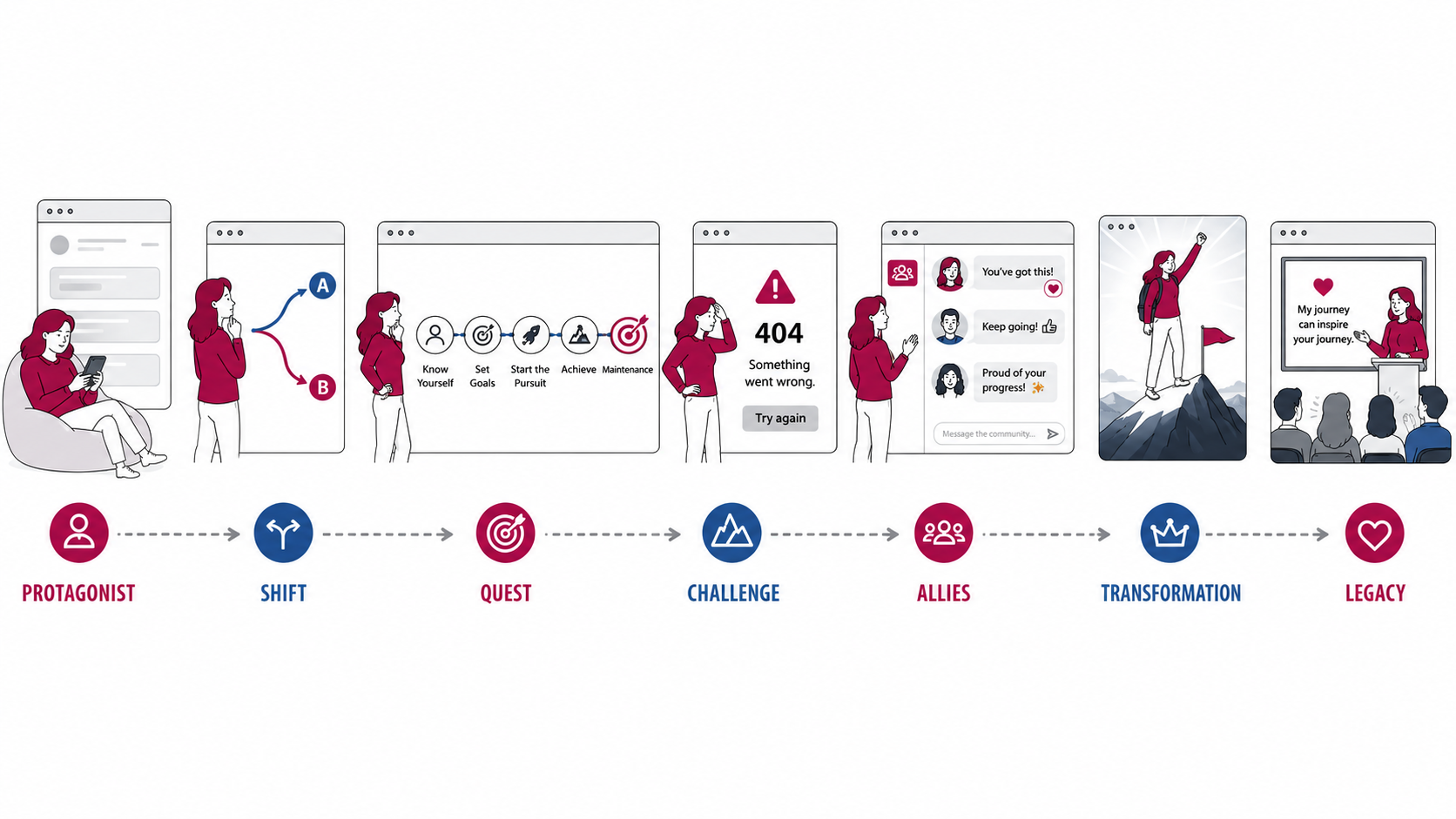
The authors of the study created a psychometric Hero’s Journey instrument to measure the hero’s mindset, distilling it into seven key stages:
- Protagonist: The individual sees themselves as the hero of their own story.
- Shift: A disruption forces them to rise to a challenge.
- Quest: The hero pursues a meaningful goal or purpose.
- Allies: Supportive friends, mentors, or guides assist along the way.
- Challenge: Villains and obstacles test the hero’s strength and resolve.
- Transformation: The hero grows and gains deeper self-understanding.
- Legacy: The hero gives back, leaving a lasting impact.
People who see their lives through this lens report significantly higher levels of meaning and purpose, along with stronger scores across a range of psychological well-being metrics.
Over the last few years, I’ve increasingly come to see us as a narrative species. Our sense of self, our connection to family and culture, and even our experience of meaning — or meaninglessness — are shaped by the stories we interject and share . Psychologists and neuroscience refer to this as our narrative identity.
This study fits perfectly with other research on the “narrative self,” which shows that kids who grow up with a richer understanding of their family history tend to develop stronger psychological resilience and mental health. Basically, the better you know your family gossip, the more mentally strong you become.

Re-story your life as a hero
What’s most fascinating about the study is that the researchers turned this insight into a therapy. By encouraging people to reframe their life story as a Hero’s Journey, they boosted psychological well-being across the board.
Just by re-storying their lives, participants saw improvements in meaning, resilience, work satisfaction, overall flourishing—and even reductions in depression symptoms.
It’s a simple exercise with surprisingly powerful effects. So why not give it a shot?
I’ve extracted the core questions from the study. If you’d like to lift your spirits and experience the psychological benefits, take a few minutes to work through these. The more deeply you explore them, the more you’ll reframe your life as a hero.
Spend some time thinking through each of these questions:
- Protagonist: What makes you, you? Reflect on your identity, personality, and core values.
- Shift: What change of setting or experience prompted your journey to become who you are today?
- Quest: What meaningful goal have you been striving toward?
- Challenge: What obstacles—rivals, setbacks, or hardships—stood in your way?
- Allies: Who supported or helped you on your journey?
- Transformation: How have you grown or changed along the way?
- Legacy: What impact has your journey had on others or the world around you?
Before moving on, take a few minutes to reflect on these questions. Thinking through them will help you internalize the framework more deeply than a quick read, or simply knowing it conceptually.
Explore hero-centered design
For those working in UXD, behavioral design, or health behavior change, the Hero’s Journey offers a powerful new framework. Any project aimed at helping people pursue meaningful goals could be structured around this timeless narrative arc.
We already have countless products designed to help users achieve difficult goals — fitness, career growth, mental health, habit change. Why not experiment with building these around a Hero’s Journey framework?
Let’s explore how the journey aligns with popular psychological models, using examples from my prior meta-analysis on the psychology of health behavior change technology.
1. Protagonist:
We can represent users with icons, avatars, or other symbols, but I prefer to design interfaces as if I were looking through the user’s eyes. In a Hero’s Journey, the interface is their world—and it’s also where we, as their friend, coach, or mentor, our editorial voice provides support as we guide them on their journey.
2. Shift:
This reminds me of Prochaska’s Stages of Change model, where sometimes a dramatic event jolts people out of complacency and onto the path of transformation, from denial to contemplation.
In health behavior change products, screeners offer a simple way to prompt users into action. Users complete a short questionnaire and receive a report. If it reveals a problem—like a health risk—it leverages that concern to shift them toward a larger digital program.
3. Quest:
Every quest starts with a goal and a commitment to reach it. In my meta-analysis, goal setting emerged as not only one of the most popular behavior change techniques but also the most effective.
If your product doesn’t have a clear goal, the Hero’s Journey might not be the right fit. But if it is, you’ll typically want to get users started on their quest right away—by guiding them to set their goals as early as possible.
4. Allies:
Just as heroes rely on their friends for developing skills and getting out of impossible situations, behavioral interventions rely on social support, skill development, and self-efficacy — proven drivers of successful change.
In product design, you can think of Allies as the support systems and tools that help users along their journey. In health behavior change, this often includes cognitive behavioral therapy or other educational programs that teach users to help themselves. You might offer training material, coaching, AI agents, or support staff—all ready to step in when your hero-users find themselves in a bind.
5. Challenge:
Every great story thrives on its impossible challenges. Once users take the first step toward their goal, they start facing challenges.
At this stage, we build our products using feedback loops—formally known as control theory—by providing a continuous stream of feedback on performance, helping users understand whether they’re progressing or falling behind.
Setting the right level of challenge is crucial. As Flow Theory teaches us, easy quests are boring, while impossible ones can be overwhelming. The art lies in designing obstacles that keep users in a state of flow—not too easy, not too hard—through a cycle of climactic peaks and resolutions.
Based on our users’ goals, we reward their progress and may apply punishments when they fall behind. But it’s just as important to offer supportive messages—so our hero never sinks into despair and always finds their way back on track.
6. Transformation:
Heroes evolve, and so do people in behavioral interventions. Escaping financial stress, breaking unhealthy habits, or overcoming addiction are profound achievements — true marks of heroism.
If your users authentically achieve meaningful results—then it’s truly a time for big celebration. It’s also the perfect moment to pause and reflect on how far they’ve come.
7 Legacy:
Every hero leaves a legacy. In product design, these are the stories of success that echo an eternity, inspiring new heroes to begin their own journeys.
Consider creating a hall of fame, leaderboards, or other forms of acknowledgment to celebrate their success. Recognition is one of the most cost-effective rewards you can offer—and by sharing these success stories, you’re also promoting your product. Celebrating users’ legacy is a true win-win.

Adapt your product plot
If you’re intrigued by the idea of hero-centered design, consider integrating a Hero’s Journey theory of change for your product. It can provide a more fulfilling way to help users develop new skills, overcome challenges, and reach meaningful goals.
That said, to use this framework, you may need to reintroduce an important stage from Campbell’s framework that was left out of the study: Meeting the Mentor. This comes right after the hero refuses the call to adventure, when they feel unprepared or unskilled for the challenge ahead, and may not have accepted the quest yet.
Think about it: could Luke Skywalker have taken on the Empire without Obi-Wan, Yoda, and the cultivation of his power to use the Force? Of course not.
The hidden truth of many behavioral interventions is that they’re only partly about motivation; and they’re primarily about skill development. This means that for intervention designers, you’re Yoda, you’re Merlin, you’re the eternal coach and mentor. It’s your job to give your users the skills they need, to overcome their challenges, and find their holy grail.
And if you’re a leader — or anyone looking to inspire — consider this framework as an empirical model, as old as Gilgamesh, as a tool to help people find deeper purpose as they confront challenges and strive toward what truly matters in their lives.
For my own Hero’s Journey, I now see the next chapter of my work turning the behavioral science lens towards a new phenomena, the narrative structures that shape how we build our lives, our families, and ultimately, our civilizations.
This study is the first I’ve come across showing genuinely impressive, positive impacts from re-storying life through this ancient narrative arc.
While the science in this area is new, I believe it’s absolutely worth exploring.
Bibliography
Brun, Y., Di Marzo Serugendo, G., Gacek, C., Giese, H., Kienle, H., Litoiu, M., … & Shaw, M. (2009). Engineering self-adaptive systems through feedback loops. In Software engineering for self-adaptive systems (pp. 48-70). Berlin, Heidelberg: Springer Berlin Heidelberg.
https://link.springer.com/chapter/10.1007/978-3-642-02161-9_3
Csikszentmihalyi, M., & Csikzentmihaly, M. (1990). Flow: The psychology of optimal experience (Vol. 1990, p. 1). New York: Harper & Row.
https://www.google.ca/books/edition/Flow/QVjPsd1UukEC
Cugelman, B., Thelwall, M., & Dawes, P. (2011). Online interventions for social marketing health behavior change campaigns: a meta-analysis of psychological architectures and adherence factors. Journal of medical Internet research, 13(1), e1367.
https://www.jmir.org/2011/1/e17/
McAdams, D. P., & McLean, K. C. (2013). Narrative identity. Current directions in psychological science, 22(3), 233-238.
https://journals.sagepub.com/doi/10.1177/0963721413475622
Prochaska, J. O., & Velicer, W. F. (1997). The transtheoretical model of health behavior change. American journal of health promotion, 12(1), 38-48.
https://journals.sagepub.com/doi/abs/10.4278/0890-1171-12.1.38
The main paper in this article:
Rogers, B. A. et al (2023). Seeing your life story as a Hero’s Journey increases meaning in life. Journal of Personality and Social Psychology, 125(4), 752.
https://pubmed.ncbi.nlm.nih.gov/36972106/
Shoutout to Dr. Linda Pagani, who first introduced me to this area of therapy. And shoutout to the Canadian Behavioural Interventions and Trials Network conference in St. John’s, where we had the pleasure of meeting.