
Behavioral science and psychology can genuinely transform a digital product. But that’s only half the story, and it’s the half that gets all the attention.
The other half is the backfire: what happens when psychology is misapplied so badly that it triggers the opposite of the intended behavior. Think of the brand that tries so hard to win your trust that it triggers distrust instead. Or the social media expert whose small follower count undermines the very authority they’re trying to project.
What follows is a plain-language summary of a peer-reviewed paper on how psychology backfires in behavior change technologies. Dr. Agnis Stibe (MIT Media Lab) and I co-authored the paper, which you can download here: Stibe, A., & Cugelman, B. (2016). Persuasive backfiring: When behavior change interventions trigger unintended negative outcomes. In International conference on persuasive technology (pp. 65–77). Cham: Springer International Publishing.
This article covers the key concepts and offers a practical risk management approach, one that’s more realistic than trying to eliminate backfires entirely.
What people get wrong about behavioral science
When teaching digital psychology, a consistent pattern of misconceptions comes up. People often believe they can build addictive or highly engaging products by simply gamifying their app or layering on social pressure. These principles can work in the right context. But without practical or scholarly grounding, professionals risk misunderstanding the conditions that govern these principles, how different principles interact, and how badly things can go wrong when they don’t.
How to NOT discredit yourself
Perhaps the biggest misconception in behavioral science is that psychology always produces the desired outcome. Speak to anyone who works as an impact evaluator and you’ll hear a very different story. Outcomes are often far smaller than organizations admit, and there’s plenty that can go wrong.
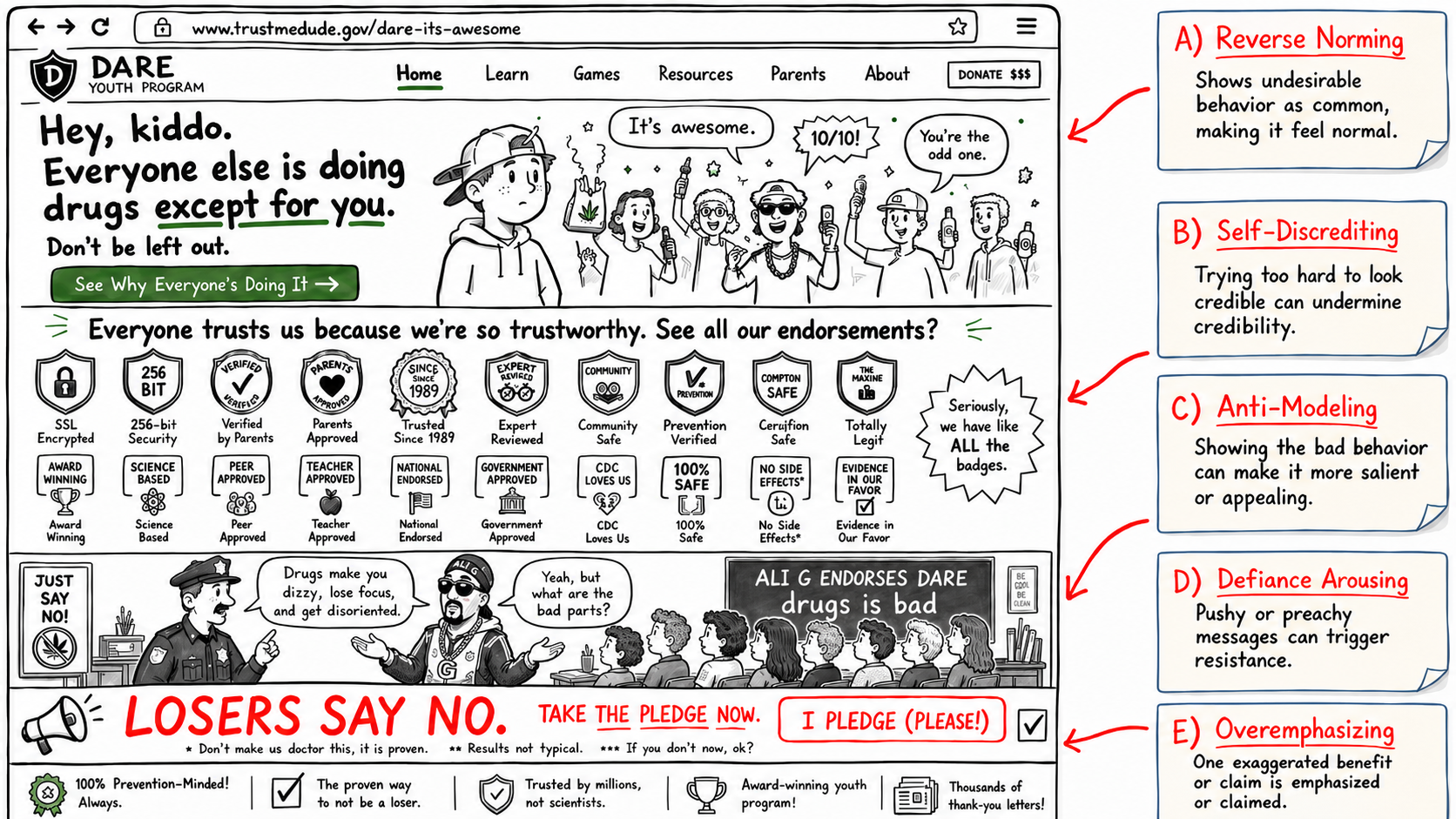
The highest-stakes risk is trying to win user trust while accidentally losing it. This is called self-discrediting: when a source disseminates information that undermines its own credibility.
Consider a developer who learns that customers don’t feel safe purchasing on their e-commerce site. They respond by rolling out the next version of their checkout page with six safety certificates, anti-virus badges, a gold seal covering their return policy, guarantees, testimonials, big brand logos, customer helplines, and enough lock-and-shield imagery to evoke Fort Knox. They tell users the site is 100% safe and secure.

Does stacking all those trust-building elements guarantee higher trust and sales? Or is there a point where you’ve overdone it so badly that you trigger distrust instead?
Trust is a sensitive principle that backfires easily. Think about it in everyday life: how often do you trust someone who has to tell you to trust them?
People decide whether to trust a website in a fraction of a second, often based on superficial design cues. Some also check third-party reviews. In our fictional e-commerce example, there’s a threshold where too many stacked trust mechanics trigger a threat response instead of reassurance. The site reads as untrustworthy. Sales drop. The developers haven’t built credibility. They’ve destroyed it.

Overdoing trust signals can backfire in more ways than one. Added complexity is as damaging as added mistrust.
Four outcomes of behavior change interventions
Behavior change interventions aim to shift beliefs, attitudes, intentions, and ultimately behavior. But there’s a more useful way to classify what actually happens. In the paper, Dr. Stibe and I arranged outcomes into four categories using the Intention-Outcome matrix below.
One axis tracks whether an outcome is intended or unintended. The other tracks whether it is positive or negative.

Intention-Outcome matrix
The four quadrants are defined as follows:
- Target behavior: The intended positive behavioral outcome being sought and typically reported. For example, increasing trust and sales in an e-commerce funnel.
- Surprise behavior: An unintended positive outcome that wasn’t sought, but is positive nonetheless. For example, attempts to boost trust in the buying process that also strengthen overall brand perception.
- Dark patterns: An intended negative outcome, such as deception or fraud, when persuasion is used for the benefit of a bad actor. For instance, trust-building tactics deployed inside a phishing scam.
- Backfiring: Unintended negative outcomes where the opposite of what was intended occurs, such as triggering distrust instead of trust. This quadrant is further subdivided into a risk management matrix that contrasts the likelihood of backfiring with its potential severity.
A risk management approach to psychological backfires
Backfires are present in all persuasive media to some degree. No interactive technology or campaign will ever be 100% backfire-free. Rather than advocating for their total elimination, the more practical position is to learn to manage them.
Below is the Likelihood-Severity matrix, a risk management framework built using a consensus-based approach. It arranges different types of backfires by how likely each is to occur and how severe the consequences could be.

Likelihood-Severity matrix
The matrix identifies six broad categories containing 12 types of backfires. The taxonomy was developed from a systematic review of academic papers, program evaluations, and practitioner case studies using a grounded theory methodology. To the best of our knowledge at the time of publication, this was the first systematic study of backfiring risks in persuasive technology. We encourage other scholars to extend it.
Here is each category and type:
Inexperience
- Superficializing: The superficial application of theory. Copying surface-level tactics without understanding the underlying strategies, principles, or reasoning behind them.

Research shows that gamifying apps like Foursquare may cease to be persuasive over the long term, and may deplete intrinsic motivation.
Fineprint fallacy
- Overemphasizing: Motivating people to take action for one strongly emphasized benefit while omitting or hiding harmful factors buried in the fine print, ingredients, or details.

Louisville-based KFC announced in 2006 that all 5,500 of its U.S. restaurants stopped frying chicken in artery-clogging trans fat.

A classic overemphasis pattern: badge the low-sodium claim prominently, say nothing about the high trans fat content.
Personality responses
- Defiance arousing: Triggering resistance to messages that are incompatible with a person’s self-identity. This can induce cognitive dissonance, leading the audience to reject or actively oppose the message.

Cover of a “Youth Smoking Prevention: Raising Kids Who Don’t Smoke” Philip Morris study, Vol. 1: Issue 2. “Talk, They’ll Listen” was the tagline. The study was later found to actually encourage more teens to smoke.
- Self-licensing: When someone does something good in one area, they sometimes feel licensed to behave poorly in another. Research shows that after donating to charity, people may feel freer to act less morally in subsequent decisions, including becoming less environmentally conscious.
Credibility damage
- Self-discrediting: When the source disseminates information that undermines its own credibility, causing a misalignment between source credibility and message credibility.
- Message hijacking: When a third-party actor recontextualizes the source’s message with a different meaning, typically turning it into a public joke or parody that undermines the original intervention.

Stoner Sloth was an Australian anti-drug campaign that backfired badly. The campaign, which portrayed a stoned sloth in teenage situations, was mocked online. The community hijacked stonersloth.com.au as a parody site, and a Twitter account followed.

The logo for the hijacked StonerSloth.com Twitter account. From their profile: “Stoner Sloth seeks out and reviews the best Canna-companies in Colorado to help you enjoy your smoking experience with a whole lot less work on your part!”

Bono endorsed the BBC’s “Beat Bullying” campaign, which backfired as bracelet wearers suffered increased attacks from their bullies.
Poor judgment
- Mistailoring: When a tailored messaging system produces negative outcomes in some users, outcomes that a better-targeted message would have avoided.

A drinking screener showed both low and high drinking students how much they consume compared to average. Those above the norm felt encouraged to drink less. Those below received an implied message to drink more.
- Mistargeting: When a message intended for one audience is misinterpreted by a different group entirely.

The Playpump removed perfectly functional water pumps in South Africa and replaced them with a cumbersome toy that relied on child labor to operate.
- Misdiagnosing: When a behavior change intervention fails to properly diagnose user behavior or psychological processes, causing it to intervene at the wrong moment or in the wrong way. In one documented case, a gaze-tracking system offered proactive help as patients read medical documents, using lengthy fixation time as a cue for difficulty. Participants with low health literacy read more slowly, causing the system to offer help continuously. The result was annoyance, not support, and lower comprehension than the control condition.
- Misanticipating: Changes in policies or directives that lead to unanticipated shifts in behavior. What worked before the change may produce unintended consequences after it.
Social psychology
- Anti-modeling: Demonstrating negative behavior in order to demonize it raises awareness of that behavior and can prompt people to engage in it, especially during moments of susceptibility.
- Reverse norming: Interventions that use examples of widely practiced bad behaviors can inadvertently establish those behaviors as a social norm, making them appear acceptable or expected.

Two separate studies found that the D.A.R.E. program was ineffective and, in some cases, pushed kids toward drug use and lowered self-esteem. Researchers suspected the intervention’s message made some kids want to try drugs as a way of fitting in. Read this web banner, then ask yourself: what outcome might result from an anti-drug banner that suggests kids want to be on drugs?
Strategies to reduce psychological backfire risks
Removing every potential backfire from a product or campaign is not realistic. The goal is to manage them systematically and cost-effectively.
- Know the limits: No matter how carefully you design, some aspect of your product will produce negative effects in some populations. Accepting this keeps you scanning for problems rather than assuming you’ve solved them.
- Prioritize by risk: Not all backfires carry equal weight. Superficializing tends to produce something that simply doesn’t work, wasting time and money but causing little direct harm. Social psychology backfires are more likely to cause real harm. Use the Likelihood-Severity matrix as your guide: start with quadrant D and check for anything that could trigger anti-modeling or reverse norming outcomes. Move to quadrant C, then B, then A.
- Catch backfires early: It costs far less to remove a backfire from a product under development than to fix one after launch. The best time to address a bad situation is before you’re in it.
- Scan continuously: Since you’ll never fully eliminate all backfires, stay vigilant. Ask: “What can go wrong?” Plan: “If it did occur, what would we do?”
- Test rigorously: Even experienced behavior change professionals can rarely predict which messages and design patterns will perform with a new population. What they can do is run a well-structured experiment to find out. Science tells you which principles should work in theory. Testing tells you what works in practice. Conversion rate optimization research is one of the most effective tools for identifying the psychological ingredients that lift persuasiveness while reducing the worst backfires.
Why backfires are widespread but rarely reported
There’s an irony built into the research itself. When you finally identify the psychological principle that triggered a backfire, it lands like the punchline of a good joke. The absurdity of doing X to achieve Y becomes obvious at a glance. Writing the paper, Dr. Stibe and I found ourselves laughing regularly at the examples.
The humor disappears quickly if the backfire is your own campaign.
The stigma around reporting a backfiring intervention runs deep. Researchers who publish on this topic risk being stigmatized and dismissed. Practitioners face reputational damage. The result is a significant publication bias: positive outcomes are overreported, negative ones are suppressed, and the scientific literature reflects a more optimistic picture of what behavioral interventions actually do than the evidence warrants.
This bias creates real risk. When the literature systematically underreports failure, both researchers and practitioners are more likely to repeat the same mistakes. The more openly the field discusses what goes wrong, the better equipped everyone becomes to avoid it.
Acknowledgments
This summary was authored by Brian Cugelman. I’d like to thank my co-author Dr. Stibe, all those who contributed examples and feedback, the Persuasive 2016 conference for accepting our paper, and Jesse Ship for bringing the editorial scalpel to this article.
References
- Stibe, A., & Cugelman, B. (2016, March). Persuasive backfiring: When behavior change interventions trigger unintended negative outcomes. In International conference on persuasive technology (pp. 65-77). Cham: Springer International Publishing. https://dspace.mit.edu/entities/publication/a9b08067-ad75-4582-a552-031c8bf136ef